For More Information Email success@honorsbiohub.com
The Central Dogma
Blog post description.
TOPICS
1/25/20262 min read
The Central Dogma: How Your Cells Make Proteins
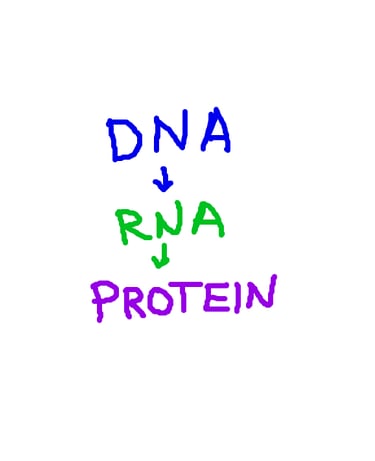
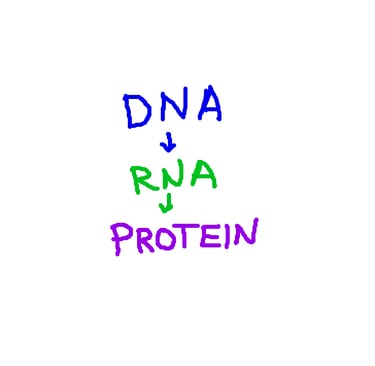
The Central Dogma is an essential concept found in all Honors biology classes. Be aware that the level of detail for this topic can vary but generally the processes involved can be somewhat complex. Every cell in your body contains an incredible instruction manual: your DNA. But DNA doesn't do the work itself. Instead, it directs the production of proteins, the molecules that perform nearly every function in your body. The process by which DNA's information becomes functional proteins is called the central dogma of molecular biology, and it follows a specific one-way flow. DNA makes RNA, and RNA makes protein.
DNA: The Master Blueprint
DNA, or deoxyribonucleic acid, is stored safely in the nucleus of your cells. Think of it as a reference book in a library that never leaves the building. This double-stranded molecule contains all the genetic instructions needed to build and maintain your body. Each gene is a specific section of DNA that codes for a particular protein.
Transcription: Copying the Instructions
Because DNA is too valuable to leave the nucleus, cells make a temporary copy of the genetic information. This process is called transcription. An enzyme called RNA polymerase unzips a section of DNA and creates a single-stranded molecule called messenger RNA, or mRNA. This mRNA is complementary to the DNA template, meaning it carries the same information in a slightly different molecular form. The key difference is that RNA uses the base uracil (U) instead of thymine (T).
Once the mRNA copy is complete, it exits the nucleus through nuclear pores and travels into the cytoplasm, where the next step takes place.
Translation: Building the Protein
In the cytoplasm, the mRNA finds a ribosome, which is the cell's protein-making factory. Here, the process of translation begins. The ribosome reads the mRNA sequence in groups of three bases called codons. Each codon specifies a particular amino acid. Transfer RNA (tRNA) molecules bring the correct amino acids to the ribosome, where they're linked together in the order specified by the mRNA sequence.
As the ribosome moves along the mRNA, the chain of amino acids grows longer. When complete, this chain folds into a specific three-dimensional shape, creating a functional protein.
Why It Matters
The central dogma is "central" because it's fundamental to all life. Understanding this process helps explain how genetic mutations cause diseases, how cells respond to their environment, and how organisms pass traits to their offspring. This one-way flow of genetic information from DNA to RNA to protein is the foundation of molecular biology and the key to understanding how life works at the cellular level.
READ MORE:
RNA Processing ("learn more about how mRNA is processed after transcription")
Restriction Enzymes ("enzymes that interact with DNA")
Help
Questions? Reach out anytime, we're here.
Contact
Success@HonorsBioHub.com
© 2026. All rights reserved.